
Introduction
In the ever-changing world of fashion, where new trends emerge with every passing season, one timeless truth continues to hold power: fashion fades, but style is eternal. This iconic phrase, first uttered by the legendary Yves Saint Laurent, has become more than just a quote — it’s a philosophy, a way of life that celebrates individuality over imitation. While fashion reflects the moment, style captures the soul. It’s what remains when the novelty of trends has worn away, leaving behind the essence of who you truly are.
Each generation brings its own definition of beauty, experimenting with colors, fabrics, and silhouettes that define an era. Yet, through all these transformations, certain looks endure — a perfectly tailored blazer, a little black dress, or a crisp white shirt. They transcend the shifting waves of fashion because they are rooted in simplicity and authenticity. That’s the quiet magic of style: it’s personal, enduring, and effortlessly expressive.
In today’s digital age, where trends rise and fall overnight through social media, understanding the difference between fleeting fashion and everlasting style has become more vital than ever. True elegance lies not in chasing every new look but in curating a wardrobe and presence that tell your story with confidence and grace. This article explores what makes style eternal, how icons like Saint Laurent shaped this philosophy, and why cultivating timeless style is the key to standing out in a world obsessed with the next big thing.
The Meaning Behind “Fashion Fades, Style Is Eternal”
At first glance, “Fashion fades, style is eternal” may sound like a simple remark about clothing, but it carries far deeper significance. Yves Saint Laurent’s words distill the essence of personal expression in an industry often driven by rapid change. Fashion, in its truest sense, represents the now — the collective mood of society, the aesthetic heartbeat of a specific time. It’s dynamic, often impulsive, and thrives on reinvention. Yet, as Saint Laurent observed, those same trends that capture our fascination today are destined to lose their allure tomorrow.
Style, however, resists time. It’s not about what’s trending but about who you are and how you choose to present yourself to the world. A person with true style interprets fashion rather than follows it. They don’t just wear clothes — they tell stories through them. This difference is what sets apart the merely fashionable from the genuinely stylish.
To embody eternal style means understanding what resonates personally — the cuts that flatter, the colors that comfort, and the silhouettes that express your individuality. It’s about cultivating self-awareness rather than chasing validation. Whether you draw inspiration from vintage tailoring or modern minimalism, the foundation remains authenticity.
In essence, this quote isn’t a rejection of fashion but an invitation to look deeper. Fashion provides the tools — fabrics, trends, ideas — but style gives them meaning. It’s the invisible thread that weaves confidence, personality, and grace into everything you wear. That’s what makes it eternal.
Fashion as a Reflection of Time
Fashion has always been a mirror of society. From the opulent corsets of the Victorian era to the rebellious denim of the 1970s and the digital-inspired minimalism of today, fashion captures the collective mood of its time. It tells stories of liberation, identity, and change. Every stitch and silhouette reflects not only design trends but the cultural shifts that shape how people live and think.
In that sense, fashion is inherently temporary — it evolves because society does. Designers respond to the political, social, and technological climates around them. When women gained independence, hemlines rose. When technology accelerated, fabrics became lighter and more adaptable. Fashion thrives on this cycle of change, offering constant renewal and excitement.
Yet, this same impermanence can also make fashion superficial. What’s “in” today can easily become passé tomorrow. The rapid churn of trends, intensified by social media and fast fashion, has only deepened this sense of transience. But perhaps that’s what makes fashion fascinating — its power to reinvent itself endlessly while echoing the values of the present.
Recognizing fashion as a reflection of time helps us appreciate its artistry without mistaking it for permanence. It’s a visual diary of humanity’s evolution — expressive, emotional, and sometimes fleeting. But it’s precisely this fleeting nature that gives style its contrasting strength. Where fashion captures a moment, style defines a lifetime.
The Legacy of Yves Saint Laurent
Few designers have left a mark on the fashion world as profound as Yves Saint Laurent. More than a couturier, he was a visionary who understood that style is not merely about adornment — it is an expression of identity. His declaration, “Fashion fades, style is eternal,” was not an act of defiance against trends but rather a celebration of individuality. Saint Laurent’s genius lay in his ability to merge elegance with empowerment, creating designs that were as intellectual as they were beautiful.
From his early days at Dior to the creation of his own label in 1961, Yves Saint Laurent challenged conventions. He blurred the boundaries between masculine and feminine, introducing the iconic Le Smoking tuxedo suit for women — a look that redefined sophistication and symbolized strength. Through his collections, he paid homage to art, culture, and the complexities of human emotion. His work was timeless not because it resisted change but because it embraced it with intention and grace.
Saint Laurent’s legacy endures not just in garments but in philosophy. He believed in the democratization of fashion — that every woman should have access to elegance. His ready-to-wear line, Rive Gauche, revolutionized the industry by blending haute couture craftsmanship with accessibility. Today, his influence resonates in the effortless chic we associate with French style: confident, understated, and eternally relevant.
Ultimately, Yves Saint Laurent’s legacy is more than aesthetic — it’s philosophical. He taught the world that style is about knowing oneself, not imitating others. That’s what makes his words resonate as strongly today as they did decades ago.
Redefining Elegance Through Innovation
When Yves Saint Laurent entered the scene, elegance was often equated with restraint — a kind of rigid perfection that left little room for individuality. But Saint Laurent changed that narrative. He understood that true elegance had to evolve, to breathe. His designs introduced a new kind of sophistication: bold yet refined, structured yet sensual.
One of his most groundbreaking contributions was his ability to fuse high art with fashion. His 1965 Mondrian Collection, inspired by the Dutch painter Piet Mondrian, transformed dresses into wearable masterpieces. He blurred the line between gallery and runway, proving that fashion could be intellectually stimulating while remaining wearable.
But perhaps his greatest innovation was emotional. Saint Laurent gave women power through clothing — not in a symbolic way, but through tangible design. The Le Smoking tuxedo, for instance, wasn’t just a suit; it was a statement. It challenged gender norms and celebrated self-assurance. Women who wore it didn’t just look different — they felt different.
His vision of elegance was not about decoration; it was about authenticity. “Elegance,” he once said, “is forgetting what one is wearing.” That effortless grace remains the foundation of modern style. It’s why decades later, designers still reference his silhouettes and philosophies.
Saint Laurent’s elegance was eternal because it was inclusive. It acknowledged individuality and encouraged expression. In a world obsessed with reinvention, his work reminds us that innovation without essence fades — but when rooted in authenticity, it becomes timeless.
Fashion vs. Style: What’s the Difference?
Although the words fashion and style are often used interchangeably, they couldn’t be more distinct. Fashion is the external — the visible, ever-changing pulse of culture. Style, by contrast, is the internal — a reflection of one’s spirit, choices, and sense of self. Understanding this difference is what separates a follower of trends from a creator of them.
Fashion is driven by collective desire. It thrives on novelty, on the excitement of “what’s next.” Each season brings new shapes, palettes, and aesthetics designed to capture the world’s attention, only to be replaced by the next wave of reinvention. It’s playful, vibrant, and sometimes fleeting — a spectacle of imagination that mirrors society’s evolution.
Style, however, transcends time. It’s not about owning the latest pieces but about understanding oneself deeply enough to know what feels authentic. Style requires awareness — not just of trends, but of proportion, tone, and attitude. You might wear a crisp white shirt today, as someone did fifty years ago, yet make it your own through subtle details — the cuff roll, the pairing, the way you carry it. That’s the poetry of personal expression.
The relationship between fashion and style is symbiotic. Fashion provides inspiration, while style gives it meaning. When combined thoughtfully, they create something enduring — a visual signature that reflects not just the time you live in but the essence of who you are.
In the end, fashion fades precisely because it was meant to. Style endures because it’s alive — shaped by experience, maturity, and emotion. It’s not bought or borrowed; it’s built.
The Allure and Limitations of Fashion
Fashion’s charm lies in its transience. It’s exciting precisely because it changes, constantly reinventing what beauty looks like. There’s something exhilarating about a new collection — the unexpected silhouettes, the daring color combinations, the way designers reinterpret cultural moods into tangible forms. It’s theater, it’s art, it’s the pulse of modern life.
Yet, this very dynamism can also be its downfall. The obsession with the “new” often leaves little room for reflection. Trends that feel revolutionary today can feel outdated within months. The rise of fast fashion has only intensified this cycle, creating a culture of disposability — where garments are consumed, not cherished. What once symbolized creativity now risks becoming excess.
Fashion’s limitation, then, is its dependency on constant change. Its beauty exists in moments, not permanence. However, that doesn’t mean it lacks value. Fashion captures the zeitgeist — the collective energy of an era. The flapper dresses of the 1920s reflected liberation, just as the minimalism of the 1990s echoed restraint.
To truly appreciate fashion, one must see it as both fleeting and vital — a record of human expression that moves with the rhythm of time. It’s when we try to make fashion eternal that it falters. Instead, its purpose is to inspire. Style takes that inspiration and translates it into something lasting.
Fashion shows us who we are collectively; style reminds us who we are individually.
How to Build a Timeless Wardrobe
A timeless wardrobe isn’t defined by the number of garments it holds, but by the confidence it inspires. It’s not about keeping up with trends, but about curating pieces that tell your story season after season. When done thoughtfully, your wardrobe becomes a personal gallery — an evolving reflection of your life, experiences, and taste.
Building such a wardrobe begins with understanding your lifestyle. Are you drawn to structured tailoring, or do you prefer fluid silhouettes? Do you live for bold statements or quiet luxury? Once you identify your aesthetic DNA, you can invest in pieces that naturally complement it. The goal isn’t to restrict yourself, but to refine your choices — to choose quality over quantity and authenticity over approval.
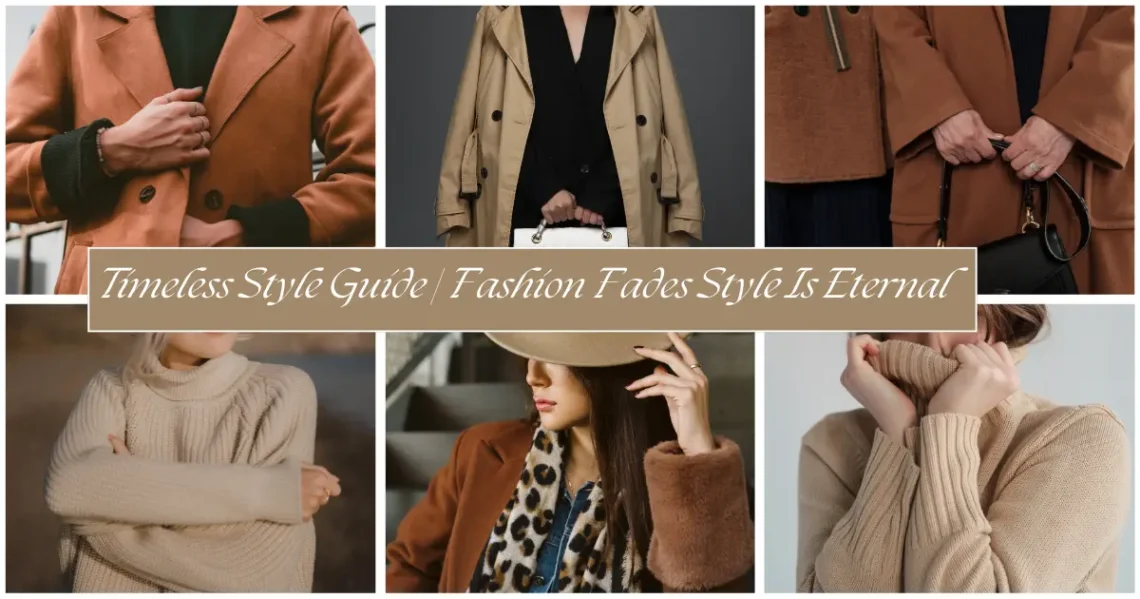
Certain elements never fail. A white shirt, perfectly cut jeans, a well-fitted blazer, a black dress, and neutral-toned knitwear form the foundation. These staples adapt effortlessly — they’re canvases you can paint differently each time through accessories and attitude. Neutral colors and timeless fabrics such as wool, silk, and cotton retain their appeal year after year, regardless of trends.
Another hallmark of a timeless wardrobe is craftsmanship. Invest in garments that are built to last — where stitching, fabric, and fit align harmoniously. Fast fashion may satisfy immediate desire, but true elegance lies in longevity. Sustainability is not just an ethical choice; it’s a stylish one.
Ultimately, a timeless wardrobe is not a uniform but a language — one that evolves with you. Trends may whisper, but style speaks — quietly, confidently, and forever.
Wardrobe Staples That Never Go Out of Style
Every era has seen its share of changing silhouettes and shifting aesthetics, yet certain garments remain unwaveringly relevant. They’re the backbone of style — pieces that adapt to every decade, every trend, and every personal reinvention.
Take, for instance, the little black dress. Introduced by Coco Chanel in the 1920s, it remains the epitome of simplicity and sophistication. It’s endlessly versatile — elegant with pearls, rebellious with leather, or understated with flats. Its power lies in its neutrality; it becomes whatever the wearer wants it to be.
Then there’s the white button-down shirt. Whether tucked into jeans or layered beneath a blazer, it speaks of confidence and refinement. The trench coat, immortalized by icons from Audrey Hepburn to modern minimalists, carries an air of quiet authority. Even the tailored blazer has evolved to suit every gender, body, and mood — structured yet free, powerful yet relaxed.
Accessories, too, play a role in timelessness. A leather handbag in a neutral shade, a pair of quality loafers, or simple gold jewelry can elevate any look without shouting for attention. These pieces don’t chase trends; they set them.
What unites all these staples is balance — they draw attention not through excess, but through design integrity. They’re versatile, adaptable, and inherently elegant. In an age of constant change, these classics serve as anchors — reminders that true sophistication doesn’t age.
Timeless staples aren’t relics of the past; they’re companions for the present. Worn with intention, they never fade — they evolve with you.
Icons of Eternal Style
True style endures long after the runway lights dim. Some individuals possess an innate understanding of elegance that transcends time — a rare quality that defies fashion’s fleeting nature. These icons of eternal style are not remembered for chasing trends, but for defining them through authenticity, confidence, and grace.
Think of Audrey Hepburn, whose minimalist aesthetic continues to inspire generations. Her affinity for clean lines, cropped trousers, and simple black dresses became the blueprint for understated sophistication. Then there’s Coco Chanel, who liberated women from restrictive corsets, replacing them with comfort, practicality, and quiet luxury — the foundation of modern femininity.
Grace Kelly, with her polished poise, and Jackie Kennedy, with her tailored silhouettes, epitomized elegance that was effortless yet deliberate. In more contemporary contexts, David Beckham, Victoria Beckham, and Kate Moss demonstrate how personal reinvention can coexist with timeless taste. Even in their experimentation, there’s consistency — a clear visual identity.
What unites these icons is not what they wore, but how they wore it. Style, after all, is an attitude — a way of carrying oneself with conviction. It’s about knowing what enhances your personality and refusing to let clothes overpower you. These individuals mastered the balance between simplicity and self-expression, between tradition and modernity.
Their influence reminds us that timelessness isn’t about perfection; it’s about purpose. True icons aren’t remembered for excess but for essence. They remind the world that elegance, when rooted in authenticity, never fades.
What Makes Their Style Enduring
The endurance of timeless style lies in its subtlety — a refined understanding of balance, proportion, and self-knowledge. For fashion icons, style was never about following rules; it was about defining them. Their choices were deliberate, anchored in personal values rather than public approval.
Audrey Hepburn’s appeal, for instance, stemmed from restraint. She embraced simplicity at a time when glamour was defined by extravagance. Her style was an extension of her personality — modest, intelligent, and radiant. Coco Chanel’s brilliance lay in her rebellion. She rejected opulence for practicality, turning simplicity into sophistication. Chanel’s tweed suits and quilted handbags weren’t just fashion statements; they were symbols of liberation.
For men like David Beckham, enduring style comes from evolution. His fashion journey — from sporty to sartorial — reflects growth, not imitation. Similarly, Kate Moss embodies the paradox of timeless cool: a mix of edge and effortlessness that feels unforced.
The secret behind their enduring appeal is consistency. Even as they adapted to changing times, their essence remained intact. They wore trends without being consumed by them, allowing personal identity to shine through.
True style icons never aim to please everyone. They dress to express, not impress. And that’s precisely why they remain relevant — their authenticity resonates across decades. Their wardrobes may evolve, but their presence never dates.
In a world obsessed with reinvention, their example reminds us that sometimes, staying true to oneself is the most revolutionary act of all.
Applying the Philosophy Today
In a digital age dominated by fast fashion, influencer culture, and endless online trends, the quote “Fashion fades, style is eternal” feels more relevant than ever. The world now consumes clothing at a pace unimaginable even two decades ago. What’s considered stylish today might be forgotten tomorrow, buried beneath a new wave of micro-trends born from social media virality. Yet amid this rapid turnover, timeless style offers calm — a kind of quiet resistance to the chaos.
Applying this philosophy today means redefining how we see fashion. Instead of chasing visibility, we prioritize identity. It’s no longer about owning everything new, but about choosing what feels true. A capsule wardrobe, for instance, built around quality essentials, represents this shift beautifully. It reflects mindfulness — both in style and in sustainability.
Social media, paradoxically, has amplified both conformity and creativity. But the individuals who stand out aren’t necessarily those in the boldest outfits; they’re the ones with coherence — a distinct aesthetic that feels genuine. Think of the influencers whose style you instantly recognize: they’re not repeating trends, they’re refining them through their own lens.
In modern times, eternal style isn’t about rejecting fashion but curating it. It’s about balance — combining the innovation of the present with the timeless codes of the past. This conscious approach to dressing fosters self-expression that endures far beyond the season. Because ultimately, in an age of constant change, authenticity will always be the most stylish statement one can make.
Staying Stylish in a Fast-Fashion World
The fast-fashion phenomenon has transformed the way we shop and perceive clothing. With collections changing every few weeks and trends dictated by algorithms, it’s easy to lose touch with personal taste. Yet, true style demands pause — reflection, intention, and selectivity.
To stay stylish in this whirlwind, one must return to the fundamentals: quality, fit, and individuality. Instead of impulse buying, focus on curating pieces that align with your aesthetic and stand the test of time. A beautifully tailored coat, well-made shoes, or a classic silk blouse can outshine a dozen fleeting trends. The aim is to build longevity into your wardrobe — to buy less, but better.
It’s also about mindfulness. Sustainable choices — supporting ethical brands, choosing natural fabrics, repairing rather than discarding — not only preserve the planet but also cultivate sophistication. There’s nothing elegant about excess; refinement lies in restraint.
Social media may promote novelty, but the truly stylish use it as inspiration, not instruction. They filter what resonates and discard what doesn’t. Remember, trends are suggestions, not mandates.
In the end, staying stylish in a fast-fashion world isn’t about resisting change; it’s about mastering it. It’s knowing that you don’t need every new item to feel current — because timelessness, by definition, never ages. Style rooted in authenticity will always outlast the trend cycle. It’s less about what you wear and more about how you wear it — with purpose, confidence, and grace.
Conclusion
In the grand conversation of fashion, where seasons change, trends evolve, and silhouettes shift, Yves Saint Laurent’s timeless words — “Fashion fades style is eternal” — continue to echo with quiet authority. They remind us that while fashion may entertain, it is style that endures. The difference lies not in the garments themselves, but in the intent behind them. Fashion is about appearance; style is about essence.
Through the decades, icons from Coco Chanel to Audrey Hepburn, and even modern tastemakers today, have shown that style transcends time precisely because it reflects individuality. It’s not dictated by magazines, algorithms, or runways — it’s defined by authenticity. The perfectly fitted blazer, the crisp shirt, the subtle gold accessory — these endure not because they resist change, but because they adapt to it while maintaining integrity.
In a world saturated with trends, rediscovering the beauty of timelessness feels almost radical. To cultivate enduring style is to know oneself deeply — to choose with purpose, to wear with confidence, and to move through the world with intention. It’s a journey that evolves with experience, age, and perspective.
Yves Saint Laurent’s philosophy isn’t simply about fashion; it’s about identity. It challenges us to think beyond fabric and form, to embrace the eternal in an age obsessed with the temporary. Style, in its truest sense, is not something you buy — it’s something you become.
So as trends come and go, and as fashion reinvents itself once more, remember: the most elegant statement you can ever make isn’t found in a store window, but in the quiet confidence of knowing who you are. Because while fashion may fade, you — and your style — are eternal.
Frequently Asked Questions (FAQs)
H4: What does “Fashion fades, style is eternal” mean?
It means trends change, but true style lasts forever. Fashion is temporary, while style reflects your individuality.
H4: Who said the quote “Fashion fades, style is eternal”?
The quote was said by Yves Saint Laurent, reminding us that personal elegance never goes out of fashion.
H4: How can I find my personal style?
Discover what makes you feel confident. Choose timeless pieces, understand your preferences, and express your personality through clothing.
H4: What are timeless fashion essentials?
Classics like a little black dress, white shirt, trench coat, jeans, and a tailored blazer always stay in style.
H4: How do I stay stylish without following trends?
Invest in quality basics, mix modern with classic, and focus on authenticity instead of fast-changing fashion trends.