

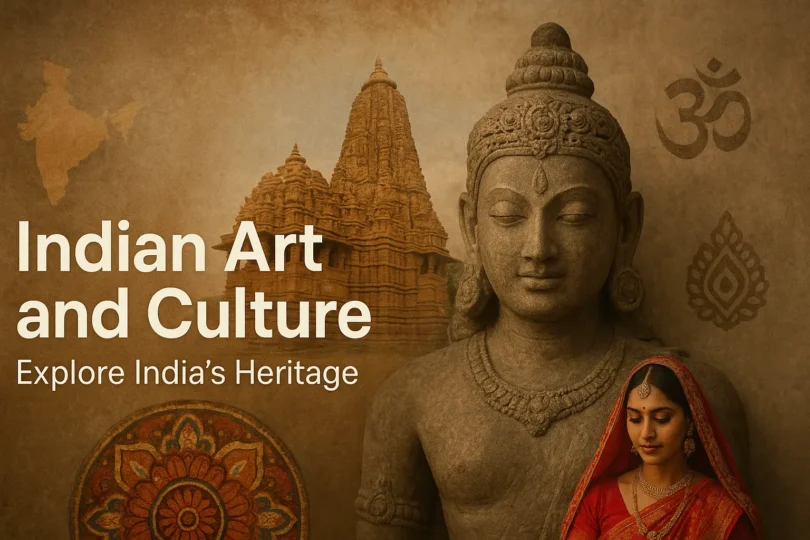

Introduction – The Soul of India’s Art and Culture
India is not just a country; it’s a story woven with thousands of colors, languages, and emotions. Every region here breathes art, every festival sings culture, and every tradition tells a tale that’s older than time itself. The beauty of Indian art and culture lies in its diversity — it’s like a grand painting where every brushstroke, whether small or big, adds meaning and emotion to the larger picture.
From the stone carvings of the Indus Valley to the soulful verses of Rabindranath Tagore, India’s creative spirit has always been boundless. The country’s art forms — music, dance, architecture, and craft — mirror the soul of its people: simple, spiritual, and deeply rooted in life’s everyday beauty.
But what makes Indian culture truly unique is how it never lost its essence, even while embracing change. The modern Indian artist uses digital brushes, yet still carries the spirit of ancient mural painters. The dancer in Mumbai performing on a contemporary stage still moves to rhythms that were born centuries ago in temples.
To explore Indian heritage is to take a journey through emotions, beliefs, and imagination — to understand how creativity becomes a form of devotion. This isn’t just about history or tradition; it’s about living art that continues to evolve. India doesn’t merely preserve its heritage; it celebrates it every single day — in colors, songs, and souls.
Ancient Roots of Indian Art
The story of Indian art begins long before written history — carved in stones, drawn on cave walls, and whispered through generations. The Indus Valley Civilization (around 2500 BCE) gave us some of the earliest examples of sculpture, pottery, and design. Tiny terracotta figurines and intricate seals from that time show how creativity and craftsmanship were already deep in the DNA of early Indians.
As centuries passed, art became a language — one that expressed not just beauty but faith and philosophy. During the Vedic and Buddhist periods, art took spiritual form. The serene faces of Buddha in Sarnath and the intricate carvings of stupas like Sanchi tell us how artists merged faith with fine detail. Every sculpture wasn’t just made to decorate — it was made to inspire inner peace.
Temples became another canvas for creativity. From the rock-cut wonders of Ajanta and Ellora to the grand Dravidian temples in South India, each structure showed artistic genius blended with devotion. The artists weren’t just builders; they were storytellers, historians, and dreamers.
Even today, when we stand before those ancient walls and statues, it’s impossible not to feel something — a quiet connection with the people who lived, created, and believed thousands of years ago. That’s the power of India’s ancient art — it doesn’t just survive; it speaks.
Evolution of Indian Architecture
Indian architecture is like an open diary — every era left its signature on the nation’s landscape. From ancient temples to modern skylines, architecture in India mirrors the journey of civilization itself.
The earliest forms came through rock-cut caves, simple yet powerful. Later, temple architecture blossomed into two main styles — Dravidian in the south, and Nagara in the north. Both were breathtaking in their own ways, filled with carvings that told tales of gods, battles, and cosmic energy.
Then came the Mughal period, when Persian elegance met Indian artistry. Think of the Taj Mahal — a symbol of love that also reflects a perfect balance between geometry and emotion. The Mughals brought arches, domes, and gardens — architecture that felt alive, peaceful, and poetic.
Colonial rule added another layer, mixing European style with local taste. You’ll still see that in the streets of Kolkata, Mumbai, or Delhi — those old post offices, churches, and universities that look British, yet feel Indian.
In modern times, architecture has gone global — glass towers rise beside ancient temples. Yet, even in the most modern buildings, the essence of India remains — color, rhythm, balance, and the spirit of creativity that never fades. Architecture here is not just about design; it’s about memory, identity, and the soul of a civilization that continues to build on its dreams.
Rich Tapestry of Indian Painting Traditions
India’s painting traditions are like a mirror reflecting its spirit — full of color, emotion, and depth. Every brushstroke tells a story, often inspired by nature, gods, folklore, or the rhythm of daily life. These paintings aren’t just art; they’re windows into centuries of imagination, devotion, and storytelling.
The earliest traces of Indian painting can be found in prehistoric rock caves — the Bhimbetka caves, where early humans painted scenes of hunting and dancing using natural colors. As time moved forward, art began to adorn temples, palaces, and manuscripts. The Ajanta murals, with their flowing lines and divine expressions, remain one of the most mesmerizing examples of classical Indian art.
Then came the era of miniature paintings — small in size but grand in detail. The Mughal, Rajasthani, and Pahari schools each had their own signature — Mughals focused on royal life and battle scenes, while Rajputs celebrated love and devotion, especially stories of Krishna and Radha. These paintings were so delicate that even a peacock’s feather could serve as a brush.
On the other hand, India’s folk art — Madhubani, Warli, Kalamkari, and Pattachitra — represented the voice of common people. These forms were made by village artists, mostly women, who used natural dyes and handmade paper. Every pattern, every line, carried meaning — often blessings, beliefs, and memories of generations.
Even in modern India, painting remains alive and evolving. Artists like M.F. Husain, Jamini Roy, and Tyeb Mehta brought Indian themes to global galleries, proving that our art can be traditional yet timeless.
Indian paintings aren’t frozen in history — they breathe, change, and continue to speak to us. Whether drawn on a cave wall or a digital screen, the Indian artist paints not just what they see, but what they feel — and that’s what makes it eternal.
Indian Performing Arts – Music, Dance, and Theatre
Indian performing arts are not merely performances — they are a heartbeat of tradition, a conversation between soul and sound, movement and meaning. For centuries, Indians have expressed emotions not just through words but through rhythm, melody, and motion. Whether it’s the gentle sway of a dancer’s hands or the deep hum of a sitar, each act feels like a prayer unfolding.
Music in India is as diverse as its languages. There are two grand classical streams — Hindustani from the north and Carnatic from the south. Both are deeply spiritual and often improvisational. A raga, for example, isn’t just a tune — it’s an emotion, a time of day, even a mood. A morning raga feels fresh like dew; an evening one melts like twilight. Over time, classical traditions mingled with folk and modern influences, giving birth to everything from ghazals and bhajans to Bollywood music that now echoes worldwide.
Dance, too, has always been sacred in India. Bharatanatyam, Kathak, Odissi, Kathakali, Manipuri — each form tells stories of gods, lovers, and life itself. Every step has a reason; every expression carries a thousand words. These dances aren’t random movements — they’re storytelling in motion, connecting past and present, temple and stage.
Theatre completes the triad of performing arts. From ancient Sanskrit plays by Kalidasa to modern street theatre (nukkad natak), drama in India has always reflected society’s joys and struggles. It brings people together — laughing, crying, questioning — in the shared magic of performance.
Together, music, dance, and theatre create the pulse of Indian culture. They don’t just entertain; they awaken something deep within — reminding us that art isn’t separate from life; it is life itself.
Indian Handicrafts and Textile Traditions
When you walk through an Indian bazaar, you can almost feel the heartbeat of the country in its handicrafts. Every handmade piece — whether it’s a carved wooden toy, a brass lamp, or a woven shawl — tells a story of patience, skill, and generations of tradition. These crafts aren’t just products; they’re living pieces of heritage that connect the hands of today’s artisans with the souls of their ancestors.
India’s handicrafts are as diverse as its regions. In Rajasthan, vibrant puppets and miniature paintings capture royal life. In Kashmir, delicate papier-mâché boxes and soft pashmina shawls reflect elegance. Down south, Tamil Nadu’s bronze sculptures and Andhra Pradesh’s Kalamkari art blend myth and mastery. Each craft form holds its own personality, shaped by geography, climate, and belief.
Then there are India’s world-famous textiles — a symphony of color and texture. From the shimmering Banarasi silk of Varanasi to the bold geometric patterns of Gujarat’s Bandhani, from Odisha’s Ikat weaves to Tamil Nadu’s Kanchipuram sarees — every fabric has its own rhythm. Even the simplest cotton handloom from a village carries centuries of artistry. These textiles are not mass-produced; they are born from rhythm — the beat of a loom, the pulse of tradition.
Unfortunately, modernization and machines once threatened these ancient crafts. But lately, there’s been a revival — designers, NGOs, and conscious buyers are bringing handcrafted art back to life. Online stores now showcase rural artisans to the world, proving that tradition can survive in a digital age.
Indian handicrafts and textiles are not just beautiful objects — they’re a bridge between past and present, village and city, hands and heart. They remind us that true art doesn’t need perfection; it just needs passion. And that, India has in abundance.
Cultural Festivals – A Celebration of Diversity
India’s festivals aren’t just dates on a calendar — they’re living, breathing moments of joy that paint the entire nation in color, sound, and emotion. Every festival here, big or small, has a heartbeat of its own. It’s not only about rituals or religion; it’s about connection — people coming together, laughing, sharing sweets, lighting lamps, and forgetting differences, at least for a while.
From Diwali’s glowing lamps to Holi’s vibrant colors, each celebration has a deeper meaning. Diwali reminds us that light always conquers darkness, both in the world and in our hearts. Holi, with its chaos of colors, washes away the dust of ego and distance — suddenly, everyone is equal under the same cloud of red, green, and yellow.
Then there’s Eid, with its spirit of sharing and gratitude, Christmas with its joy and warmth, and Guru Nanak Jayanti, echoing the message of peace and unity. India doesn’t celebrate just one kind of festival — it celebrates life itself, through every religion, every region, and every emotion.
In villages, harvest festivals like Pongal, Baisakhi, and Onam bring people together to thank the earth and the rain. In cities, cultural fairs like Surajkund Mela or Kala Ghoda Festival give artists a platform to showcase their creativity. Even small town gatherings — folk dances, kite festivals, or temple fairs — carry the same rhythm of joy and belonging.
What’s truly magical is that no matter where you go in India, there’s always something being celebrated. Festivals dissolve the barriers of class, language, and belief. They make people smile, sing, and remember what it means to be human. In every lamp lit, every drum beaten, every garland hung — India celebrates its soul, again and again.
Indian Literature and Philosophy
Indian literature and philosophy are like two rivers flowing side by side — one telling stories of life, and the other explaining its meaning. Together, they form the spiritual foundation of India’s culture, shaping how generations have thought, felt, and lived. From ancient hymns written in Sanskrit to modern novels in dozens of languages, India’s literary tradition is as vast and deep as the country itself.
It all began with the Vedas, the earliest known texts — not just religious scriptures, but poetic expressions of wonder and wisdom. Then came the Upanishads, exploring the mysteries of existence: Who am I? What is truth? These weren’t dry philosophical questions — they were deeply human reflections, full of curiosity and compassion.
The epics, Ramayana and Mahabharata, carried philosophy into storytelling. They taught duty, love, and sacrifice — lessons that are still relevant today. Every generation finds its own meaning in them. Then, over centuries, Indian literature grew in many languages — Tamil, Bengali, Urdu, Hindi, Marathi, and more — each adding its own flavor. The Bhakti and Sufi poets, like Kabir, Meera Bai, and Bulleh Shah, turned faith into poetry, blending the divine with the everyday.
In the modern era, writers like Rabindranath Tagore, R.K. Narayan, and Arundhati Roy carried India’s voice across the world — a voice that is emotional, complex, and deeply humane. Their works speak of society’s struggles, yet never lose hope.
Indian philosophy, on the other hand, continues to guide the nation’s inner rhythm. From the path of karma (action) to the search for moksha (liberation), it teaches balance — between duty and desire, mind and heart.
Together, literature and philosophy form India’s conscience — reminding us that words can heal, and thought can free.
Preservation of India’s Heritage
India’s heritage isn’t just about old stones or ancient manuscripts — it’s about memory. It’s the heartbeat of a civilization that has survived for thousands of years, and preserving it means keeping that heartbeat alive. Every monument, every piece of art, every forgotten melody is a whisper from the past, reminding us who we are and how far we’ve come.
The task of protecting this vast heritage is no small one. India is home to over 40 UNESCO World Heritage Sites, ranging from the majestic Taj Mahal to the ancient ruins of Hampi and the serene temples of Khajuraho. Each site carries centuries of stories — of kings and saints, poets and craftsmen, and ordinary people who shaped extraordinary legacies.
The Archaeological Survey of India (ASI) has been the guardian of these treasures, tirelessly working to conserve monuments, excavate historical sites, and document cultural traditions. Yet, preservation is not only about protecting what’s visible — it’s also about safeguarding intangible heritage: music, dance, language, and rituals passed down through generations.
Modern India is now blending tradition with technology. Digital archives, 3D mapping, and virtual museums are making it possible to experience history without boundaries. Students can now walk through Ajanta caves or explore the Red Fort online — a bridge between past and present built with pixels and passion.
But preservation isn’t just the government’s job — it’s everyone’s responsibility. When a young artist revives an old folk song or a local community restores a temple wall, they’re doing something sacred — keeping history breathing.
India’s heritage is a living thing. It doesn’t belong only to yesterday — it belongs to tomorrow. And as long as there are hearts that remember and hands that care, the story of India will never fade.
Conclusion – Keeping the Flame of Tradition Alive
India’s art and culture are like an eternal flame — passed from one generation to the next, glowing through centuries of change. It’s not something stored in museums or locked in dusty books; it lives in people — in their songs, their stories, their dances, and their daily lives. To explore India’s heritage is to realize that tradition here is not a memory, but a living rhythm that continues to breathe and evolve.
Every painting, every piece of music, every sculpture tells a story of resilience. Empires rose and fell, but the art stayed — quietly adapting, transforming, and carrying forward the spirit of creativity. The thread that connects a tribal painter in Odisha to a digital artist in Mumbai is not technique — it’s emotion, the desire to express beauty, devotion, and truth.
As the world rushes toward modernity, it’s easy to lose touch with roots. Yet, India shows that tradition and progress can coexist. A Kathak dancer performs to fusion music, a weaver sells handloom sarees online, and temples get preserved through 3D scanning — old souls meeting new tools. That’s not a loss of culture; it’s culture reborn.
Preserving heritage isn’t about resisting change — it’s about remembering where change began. When young Indians learn classical dance, read ancient poetry, or simply light a lamp during Diwali, they become keepers of that flame.
The beauty of India’s art and culture lies not only in its history but in its heart — in the way it teaches us to see life as sacred, every gesture as art, and every moment as celebration. As long as that feeling lives within us, India’s flame will never fade — it will continue to burn bright, lighting the path for generations yet to come.
faq
What is Indian art and culture known for?
Indian art and culture are known for their diversity, symbolism, and deep connection with spirituality and nature. Every region in India expresses its identity through art forms like classical dance, sculpture, textiles, architecture, and folk traditions. The variety ranges from the intricate carvings of Khajuraho to the colorful Madhubani paintings and vibrant festivals like Holi and Diwali. Together, they create a mosaic that reflects thousands of years of human creativity and spiritual expression.
How old is Indian culture?
Indian culture is one of the oldest in the world, tracing its roots back over 5,000 years to the Indus Valley Civilization. From the Vedic age to the Mauryan, Gupta, Mughal, and modern periods, India’s cultural heritage has continuously evolved—absorbing influences while maintaining its essence. The continuity of traditions, rituals, and artistic expressions makes India a living example of ancient civilization in the modern era.
What are the major forms of Indian art?
The major forms of Indian art include architecture, sculpture, painting, music, dance, and crafts. Temples like Brihadeeswarar, forts like Amber, and paintings such as Warli and Pattachitra highlight regional variations. Performing arts like Bharatanatyam, Kathak, Odissi, and Hindustani or Carnatic music also form the soul of Indian artistic heritage. Each form carries a story—sometimes spiritual, sometimes social, but always meaningful.
Which festivals best represent Indian culture?
Festivals like Diwali, Holi, Eid, Christmas, Navratri, and Pongal represent the essence of Indian culture—unity in diversity. Every festival celebrates a different aspect of life: light over darkness, good over evil, harvest, gratitude, or devotion. What makes Indian festivals unique is how they bring communities together, transcending boundaries of religion and language.
How does Indian culture influence the modern world?
Indian culture has inspired global fashion, music, wellness, and philosophy. From yoga and Ayurveda to Bollywood and Indian cuisine, the world has embraced elements of India’s cultural legacy. Moreover, India’s ancient ideas—like ahimsa (non-violence), karma, and meditation—have found a place in global consciousness, making Indian heritage not just historical but also timelessly relevant.








Hi, this is a comment.
To get started with moderating, editing, and deleting comments, please visit the Comments screen in the dashboard.
Commenter avatars come from Gravatar.